
Powerbank stations for businesses — mobile power for rent
Your guests, visitors, and customers can rent a fully charged power bank via app or QR code and return it to any station. Weatherproof, vandal-proof, and available 24/7.
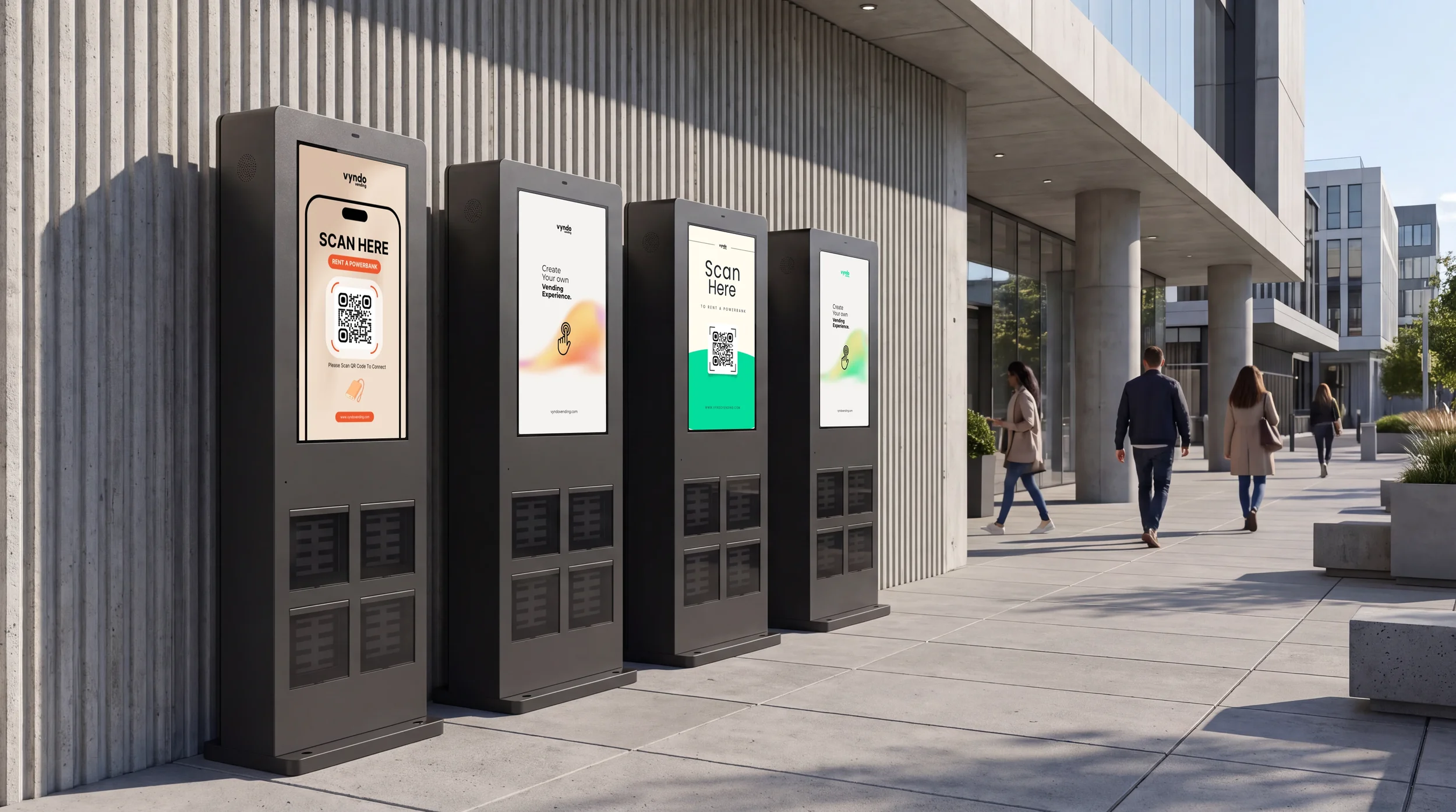
Power bank stations for any location
Your visitors can recharge while they shop, dine, or enjoy themselves. Intelligent stations with automated inventory management — no extra staff required.
Airports
City centers
Events
Hospitality
How power bank stations increase your revenue
Flexible — from 8 to 48 slots
Compact tabletop stations with 8 slots for restaurants and cafés. Floor-standing units with 24 slots for city centers and shopping malls. Large stations with 48 slots for festivals, stadiums, and train stations. Every station is network-enabled — return to any station in the network.
Weatherproof and durable
Whether in a shopping center or at a train station — the station delivers on its promise. Year-round operation from −20 °C to +50 °C, vandal-proof housing, and corrosion-resistant coating. Various sizes available for every need.
A new revenue stream with minimal effort
Every rental generates profit while keeping your visitors mobile. Three revenue models: rental fee per minute or flat rate, digital signage advertising revenue on the integrated display, or ad-supported free usage for public locations.
Your design, your station
Every station is designed in your corporate identity: exterior wrapping, display content, and app branding. For clubs, restaurant chains, and cities.
Frequently asked questions about vending machines
Three models, used individually or combined. First, the rental fee — per minute or as a flat rate, paid directly by the user. Second, digital signage advertising revenue on the integrated display, which runs while the station is on standby. Third, ad-funded free use for public locations, where a sponsor covers the rental fee and in return uses the advertising surface. Municipalities and city centers often use the third model, while hospitality and events use the rental fee. Because you can buy, rent or operate via revenue sharing, the revenue model can be tied to your investment profile. Which combination is most viable for your location, we work out together — details on the operator models are under Financing.
For the start, we recommend at least 10 to 15 stations at strategic points — train station, city center, shopping centers, dining clusters and event venues. Only from this density does the network effect take hold: guests borrow and return flexibly because there is always a station nearby. The optimal number depends on population, tourism volume and pedestrian routes. After launch, the telemetry gives you real utilization data per station, so you densify the network specifically where demand is high. That way you scale based on data rather than guesswork. For the initial planning, we analyze your location list and recommend the build type and slot size per point.
Yes. The built-in digital signage display runs whenever the station is not actively in use, and it works for your own advertising or as paid ad space for third parties. This creates a second revenue stream alongside the rental fee, the space earns even when no one is renting a power bank. You control the content centrally via the cloud dashboard and push it to any number of stations at once, for example local campaigns per district. At public locations, the model can be set up so that the ad revenue fully covers the rental fee for end users. Which of the three revenue models is most viable for your location is something we calculate together in the quote.
Yes. All outdoor stations are built for year-round operation at -20 °C to +50 °C. A vandal-proof housing and a corrosion-resistant coating withstand rain, snow and heat, so the station runs permanently even at train stations, in pedestrian zones and on festival grounds. The batteries themselves are protected against deep discharge and overheating and recharge in the slot under temperature monitoring. If a cell fails, the telemetry reports it immediately, so you replace it precisely instead of checking the whole station. For exposed outdoor locations, we recommend the floor-standing units with reinforced ground anchoring. Which design suits your location, we clarify in the consultation.
No. Return is possible at any station in the network — the guest inserts the power bank into a free slot at any station and thereby ends the rental automatically. It is precisely this network principle that makes the service attractive: the guest borrows at the train station and returns at the café, without retracing their steps. For you as the operator, the network balances the stock itself — busy stations empty out, quieter ones fill back up. The dashboard shows you the distribution of all power banks across all stations in real time. That way you see where to redistribute manually if needed, and plan new locations based on data rather than guesswork.
Via app or QR code right at the station. The guest scans the code on the display, selects a slot, and the charged power bank is unlocked, the process takes a few seconds and needs no prior registration. Payment is made by a stored card, Apple Pay or Google Pay; a deposit secures the return. Because no staff is needed, rental runs around the clock, even outside your opening hours. Every transaction appears in real time in the operator dashboard, so you track usage and revenue per station. For locations with many international guests, the interface supports multiple languages, which reduces operating errors and questions.
Still have questions?
Contact us directly. We will respond within 48 hours.
Plan your power bank network now
Whether for city infrastructure, festival services, or hospitality features — we plan your power bank network and advise you on revenue models.